
Soil Health and Human Health: Why It Matters for Your Gut, Energy, and Hormones
Apr 21, 2026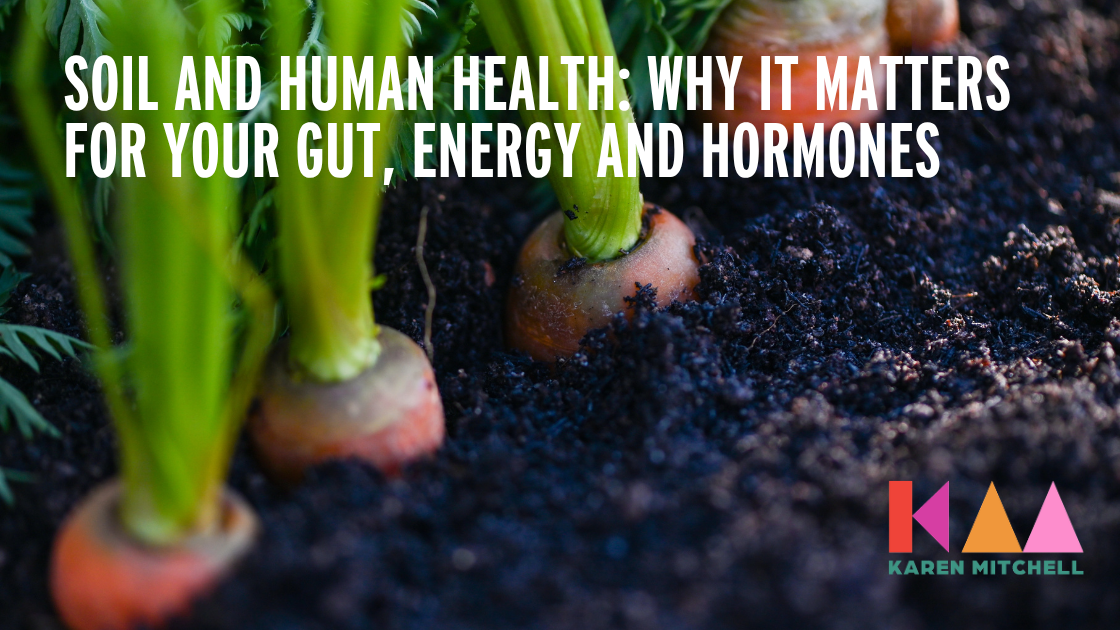
Let’s be honest—dirt isn’t sexy. Influencers aren’t talking about it, doctors aren’t talking about it, and most of us rarely think about the soil beneath our feet.
But I do.
I love soil—the color, the smell, and the silent powerhouse role it plays in sustaining life on our planet. Because “dirt” is where everything begins (plus water…). It feeds the plants, the animals, and ultimately, us.
And somewhere along the way, most of us stopped paying attention to it.
Soil Health Is Human Health
About 90% of our food comes from soil.
Not from grocery stores or meal plans, but from the ground beneath our feet. Over time, we as a society have unknowingly disconnected from the land below our feet. We’ve been trained to see a carrot in the produce section, but not in a garden. Really—just take a moment to think about what a carrot looks like above ground, or a beet, or even a green bean.
Healthy soil holds water, absorbs carbon, and supports plants through changing conditions. Right now, the changing climate is causing instability with drought and flooding. Healthy soils have a much better chance of having resilience amidst these changes.
Soil health and human health are deeply connected. Soil is essential to grow food that is actually nourishing and rich in nutrients. Beneath the surface, there is a living ecosystem of worms, fungi, bacteria, and microbes, all working together to build the quality of what ends up on your plate.
When our soils change for the worse, our bodies follow suit. It directly impacts the nutrients in our food, and over time, the way our bodies function.
How Modern Agriculture Changed Our Food
As agriculture became more industrialized, we moved toward monoculture—growing one crop over large areas, season after season. It’s crazy when you think about how rapid our food supply has changed. In just a year, we can make a change in a plant. Yet our human body takes generations to change.
American farmers and corporations believed monoculture farming was efficient, and in many ways it is. But that efficiency has come at a cost that we are only beginning to fully understand. We traded efficiency and increased income for health.
When you grow the same crop repeatedly on the same plot of land, the soil becomes depleted. Bacteria and pests that feed on that one crop get stronger year after year. To maintain yields and protect the plants from those pests, more fertilizers, herbicides, and pesticides are introduced.
This is where the effects of monoculture farming start to show up—not just in the soil, but in the quality of our food.
Over time, this disrupts the natural balance of the soil, damages microbial life both in the soil and on the plant and creates a system that is dependent on constant input rather than one that is self-sustaining and more balanced.
Now, if you’re paying attention, you might be able to say the same thing for modern health management. We need more fertilizers (vitamins to make up for what has been lost in our food or because our GI systems are not digesting as efficiently), and pesticides (antibiotics to kill off bacteria that runs amok in our weakened health systems). Our health as a society is needing more inputs to attempt to find balance.
What Nutrients Are Missing From Our Food Today
Soil isn’t just dirt—it’s a delivery system for nutrients.
About 45% of soil is made up of inorganic minerals, coming from the breakdown of rocks over time. These include macronutrients like phosphorus, potassium, calcium, magnesium, and sulfur, along with micronutrients like iron, zinc, copper, selenium, manganese, and more.
These nutrients are essential for hormone balance, energy production, and cellular function.
When soil is healthy, plants are able to pull these nutrients up and incorporate them into their structure. When soil is depleted, that transfer doesn’t happen in the same way.
This is where we begin to see a decline in nutrient density in food. If it’s not in the soil, it can’t be in the food. So we end up with food that looks the same—but is fundamentally different.
And this is where we’ve been trained to fill the gap with supplements.
Multivitamins have become a stand-in for what should be coming from food first. But supplements were never meant to replace food. They were meant to support it.
If the soil is depleted, and the food grown in it is depleted, we are constantly playing catch-up in the body.
How Soil Health Impacts Gut Health, Energy, and Hormones
Soil is not separate from your health. Everything is connected and all things matter—wise words said by my mentor Andrea Nakayama, and something I come back to often in my work.
The microbes in soil influence the plants. The plants influence your gut. And your gut influences nearly every system in the body—digestion, immunity, hormones, energy, even mood. When you start to see it this way, the connection between soil health and gut health becomes a lot less abstract.
When soil becomes depleted, the food grown in that soil changes. It may look the same, but it carries fewer nutrients and less microbial diversity. Over time, that subtle shift adds up in the body.
It’s not always dramatic at first. It can feel like low energy that never quite lifts, even after a good night’s sleep. Skin that feels dry or a little dull. Hair and nails that don’t seem as strong as they used to be. Digestion that becomes less predictable—more bloating, more sensitivity, more second-guessing what to eat. Sleep that doesn’t fully restore you, or a nervous system that has a harder time settling.
And for many women, it continues to build into patterns like hormone imbalance, sluggish thyroid function, or autoimmune conditions like Hashimoto’s.
We’re often taught to look at these as separate issues—something to fix, manage, or work around. But when you step back, they often reflect something more foundational: the body losing some of its ability to communicate clearly and stay in balance.
And that internal experience isn’t happening in isolation. It mirrors what’s been happening outside of us. Our body isn’t living in a sterile vacuum. Everything in our environment has the possibility to help or hinder our health.
We’ve lost connection with the soil. With the way food is grown. With the diversity and richness that once supported both the land and our bodies. You can’t build vibrant, lasting health on inputs that have been stripped down over time.
The Bigger Picture: Our Disconnection From Food
We have also become deeply disconnected from our food system in this country.
In many places around the world, small farms still dot the landscape, offering a diverse selection of food grown in soil that is unique to each region. In viticulture, it’s widely understood that the grape varietal is matched to the “terroir”—the soil and mineral composition that gives the wine its unique characteristics. That same concept applies to all food.
Most of us do not know where our food comes from, how it was grown, or what has changed over time. We drive to the store, grab what’s available, and move on without a thought as to how it got there.
At the same time, the cost of high-quality, nutrient-dense food continues to rise, making it harder for many people to access.
Food quality and health are directly connected, yet the system we live in does not make that connection obvious or accessible or important, really. Processed, dead foods are the more the norm.
Simple Ways to Support Soil Health and Your Body
When I think about Earth Day, I don’t think about adding more to the to-do list like planting a new tree or recycling my glass (all great things, I just do Earth Day a little differently). I think about coming back to the basics—food, water, connection, and the systems that support them.
You don’t have to grow your own food or change everything overnight. But there are small, meaningful ways to start paying attention again.
Buy local when you can, getting to know the farmers in your community, choose a wider variety of plants, and support farming practices that prioritize soil health – these are all simple steps. Find a farmer’s market, buy locally raised meat and eggs. Plant a small container of herbs on your windowsill. Find a local food scrap composter and add your kitchen scraps to their heap.
These choices support both soil health and human health, while also improving the quality of the food you eat.
A Different Way to Think About Earth Day
Let’s bring our focus to the soil this Earth Day.
To something we rarely think about, but rely on completely—for our food, our health, and the way our bodies function over time.
If You’re Wanting to Take This Further
If this resonates with you, and you’re starting to see how these pieces connect—soil health, gut health, energy, and hormones—you don’t have to figure it out on your own.
If your body has been giving you these signals, it’s not broken—it’s responding to its environment. And the good news is, we can start to shift that.
The Enso Spring Cleanse is a gentle, whole-food reset designed to support digestion, reduce bloating, and help you feel more steady in your energy. This is a great first step that you can take now.
And inside The Calm Body Project, we go deeper. We look at the body as a whole system—gut health, nervous system, food, daily habits, and mindset—and begin to rebuild in a way that is sustainable and personalized.
If you’re ready for more support, I’d love to have you there.
References:
https://www.youtube.com/watch?v=YbN0w8ijeDw Soil the Universe Beneath Your Feed
https://pmc.ncbi.nlm.nih.gov/articles/PMC7403703/ Healthy Soils for Healthy Plants for Healthy Humans
https://chriskresser.com/why-we-get-sick-and-how-to-get-well/comment-page-3/ Why we get sick and how to get well
Eating on the Wild Side: The Missing Link to Optimal Health by Jo Robinson
My BS degree in Rangeland Management from Montana State University
Get simple tips to feel like a human again—from one human to another. Join my newsletter today.
